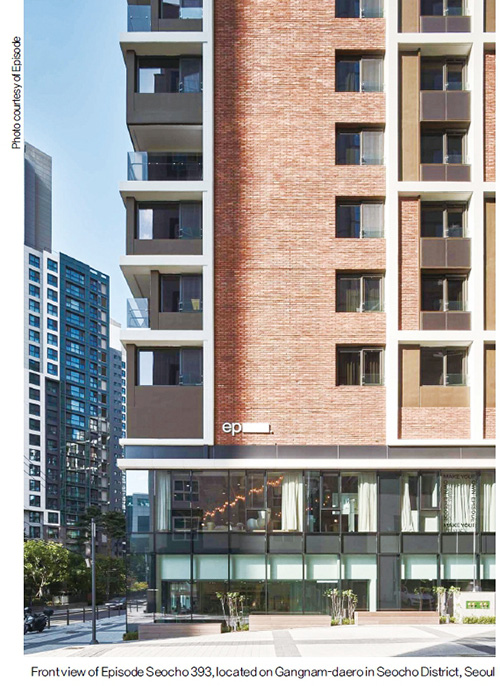
Article at a GlanceSK D&D quickly recognized the rise of single-person households and the growing need among young people to improve the quality of urban housing, and in 2016 created a dedicated task force to begin experimenting with co-living. Based on the insights gained from this effort, the company launched the community-based co-living platform “Episode” in 2020 and has since led the market. Episode initially opened Episode Seongsu101 and Seongsu121 in Seongsu-dong, then rapidly expanded its business by sequentially adding four more sites — Seocho in 2021, and Sinchon, Suyu, and Gangnam in 2022. Episode has remained popular, maintaining an occupancy rate in the 90% range despite its relatively high rent. The brand’s competitive edge lies in its expertise in community management and its home-furnished system. In particular, Episode collaborates with IKEA and MUJI to develop new concept housing units or provide subscription services that allow residents to choose furniture and small appliances suited to their personal tastes, targeting Generation Z who seek to express their individuality.
Editor’s NoteIntern Journalist Bang Ji-hye of InterBiz (third-year student in the Department of Senior Sports Education at Korea National Sport University) participated in the preparation of this article.
“Dojun, you should get your boss a pair of reading glasses. His eyes must be getting weak, since one number looks full and the other looks empty to him. People say the total population will shrink, but the number of single-person households will keep rising, which means a world is coming where we can sell a sofa in every room instead of barely selling one per home. Why wouldn’t you want to make money?”
A line from the recently popular drama “Reborn Rich,” in which one of the main characters, Jin Yang-cheol, chairman of the Soonyang Group, questions the professional manager who heads Soonyang Department Store about why he set next year’s sales target so conservatively, illustrates this point. The scene highlights Chairman Jin’s entrepreneurial ability to view the rise of single-person households as an opportunity, in contrast to the professional manager, who adopts a defensive stance by seeing social structural changes such as declining marriage and birth rates as a crisis.
As the line in the drama suggests, the number of single-person households in Korea has been steadily increasing since the early 2000s. In 1985, there were about 1,021,000 single-person households, accounting for 9% of all households, but the figure rose rapidly, reaching 27.2% in 2015 and becoming the largest household type. By 2021, the share exceeded 33.4% (7,165,788 households), marking an era in which one out of every three households consisted of a single occupant.
Copyright Ⓒ 동아비즈니스리뷰. All rights reserved. 무단 전재, 재배포 및 AI학습 이용 금지







 경제·경영 질문은